
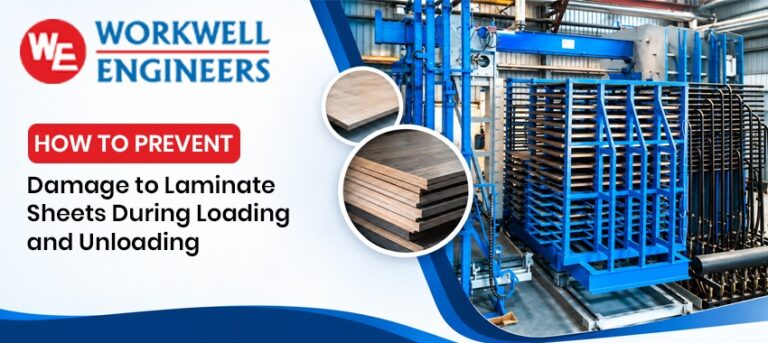
Laminate sheets are commonly found in various industries, including furniture, cabinetry, interior design, decorative surfaces, and other areas where appearance and quality of the surface is vital. Still, scratches, cracks, edge damage, and other marks can occur when laminate sheets are improperly moved. Thus, proper handling is the key to ensuring high quality of the product.
A Loading Unloading System for Laminates allows one to carry laminate sheets between different production stages in a controlled way. A good Loading Unloading System for Laminates can help the manufacturers to minimize unnecessary manual handling and optimize the position of the sheets.
What Causes Damage to Laminate Sheets During Loading and Unloading?
Damage to laminate sheets arises from improper lifting, dragging, stacking, sudden movements, contact with unsuitable surfaces, etc. Manual handling becomes complicated with large and heavy sheets or when sheets are moved in production frequently.
A Loading Unloading System For Laminates which is built well resolves the issues by allowing products to move from point to point in a controlled way. Rather than depending on lifting and transporting items manually, manufacturers can use special equipment made specifically for their unique manufacturing needs.
- Do not Drag Laminate Sheets
Dragging laminate sheets across the ground, floating on pallets or lying on tables makes scratches and other marks appear. Laminate finishes and decorative designs may be very susceptible to damage when exposed to rough contact.
Lifting and transporting sheets should be done by appropriate handling equipment. A Loading Unloading System For Laminates minimizes contact with the surfaces during transportation and provides for smooth transfer between them.
- Choose the Right Lifting and Handling Equipment
Choosing the right lifting equipment is extremely important when ensuring laminate sheets will not get damaged. When selecting equipment, one should take into account dimensions and weight of the sheets, their thickness and surface characteristics and production volume.
A Loading Unloading System For Laminates can be specifically made to lift, transfer, position and unload sheets. This will reduce the chances of accidental falls and uncontrolled movements of the items and minimize the efforts.
Manufacturers can employ conveyor belts, elevators, vacuum handlers, or specially designed systems for material management, depending on the purpose.
- Ensure Proper Alignment During Movement
Improper alignment could lead to impacts between laminate panels and machines, conflicts with other products, or wrong orientation when stacking. Consequently, this could lead to damages on edges and the overall surface of laminate panels.
A well-made Loading Unloading System For Laminates ensures reliable movement and proper positioning of laminate during the handling process, which is essential as panels may have to change their positions during the production cycle.
- Use Safe Stacking Techniques
Improper stacking may lead to bending, surface marks, edge damage, and unstable piles of material. The important condition of stacking is that laminated panels must be placed on a flat and solid base.
One of the advantages of loading-unloading systems for laminates is doing orderly stacking by placing laminate sheets where they should be. Such a possibility allows not to move them afterward and to get access to parts easily.
While choosing the right stacking method a manufacturer should pay attention to dimensions and weight of sheets and the number of them as well as the conditions of their storage before piling.
- Cut Down on Unnecessary Manual Handling
Excessive manual handling can create situations when accidental drops, scratches, and colliding with other items can occur, as well as worker fatigue. It may also slow down the production process when a considerable number of laminate sheets has to be moved from one place to another.
With the help of the Loading Unloading System For Laminates, manufacturers are able to eliminate repeated lifting and moving. The operators have more time to concentrate on managing the production process, making inspections, and doing other important things instead of moving sheets.
- Use Vacuum Handling for Sensitive Surfaces
Vacuum handling can be effective for applications that require preserving the quality of surfaces. This type of equipment can lift sheets as well as position them successfully without the necessity to use traditional gripping equipment.
When integrated into the Loading Unloading System For Laminates, vacuum handling can provide controlled lifting and positioning of laminate sheets. In addition, this method also simplifies the loading, unloading, stacking, and transferring processes.
- Choose a System Based on the Production Needs.
Each factory has only its own material handling needs. The sheet size, sheet weight, production speed, available space on the shop floor, packaging conditions, and the level of automation should be looked through in detail when choosing machines.
A particular Loading Unloading System For Laminates can be built on the process specific workflow of the specific manufacturing facility hence adapting the handling process to the production line instead of having the production process adjusted to the unsuitable equipment.
Enhance Laminate Handling with the Proper System
In order to prevent any damage to laminate sheets at each step of the material movement, proper lifting, regulated delivery, perfect alignment, safety of packing, and minimizing the manual operations has to be ensured.
Good Loading Unloading System For Laminates will allow manufacturers to reduce losses caused by spoilage of material thus improving the efficiency of production as well as the employee safety at the workplace.
Through its experience of engineering solutions for handling industrial materials, Workwell Engineers has brought out systems specifically tailored to production as well as handling materials. The right choice of handling system will enable manufacturers to enhance the quality of the laminate sheets process.
When it comes to improving efficiency and safeguarding the sheets from damages during the laminate sheets process, manufacturers should keep in mind that the right Loading Unloading System For Laminates may help them reduce material losses and achieve better workflow.