
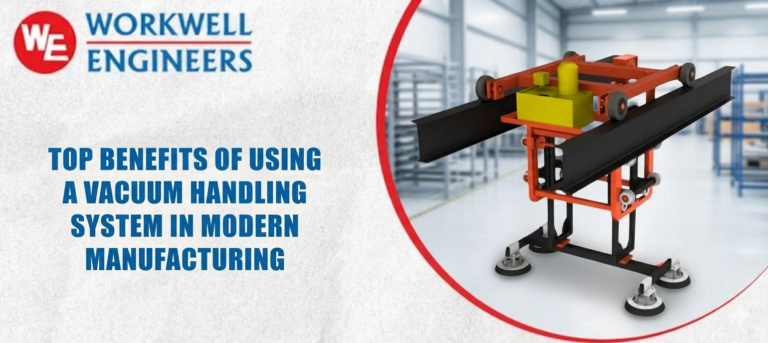
In today’s manufacturing environment, the ability to be efficient, safe, and have quality products will determine how successful you are operationally. Automation is becoming common for companies in the production of large and heavy products, allowing for a much faster productivity level, which includes less manual labor. The utilization of a Vacuum Handling System is one of the best solutions on the market today to improve productivity and reduce manual labor when handling products.
A Vacuum handling system is a technology used for lifting, moving, positioning and transferring products/materials from one location to another without damaging them. It is widely used throughout many industries like laminate, wood, glass, steel sheets, packaging, automotive and general manufacturing, to make it possible to reduce the amount of manual handling and increase the accuracy of placement during the production process. Vacuum handling systems are highly utilized for their ability to handle porous and semi-porous type materials in an efficient and ergonomic manner; making them indispensable components of modern manufacturing facilities.
What is a Vacuum Handling System?
A Vacuum Handling System uses suction pads and vacuum generators to grip and lift objects. When the vacuum handling system is attached to an object; the object can be rotated, stacked or placed with precision by the operator or an automated piece of machinery.
Compared to traditional methods that use clamps, hooks or human resources, vacuum-powered technology can handle items in a safe and controlled way without causing damage. Because of this capability, it’s also a useful solution for manufacturers working with delicate surfaces like laminate, glass panels, coated sheets, and engineered wood products.
Increased Manufacturing Productivity
Implementing a Vacuum Handling System greatly improves operational productivity. Many times, manual material handling slows production due to the limitations of lifting capabilities, worker fatigue and the need for repetitive motions.
When utilizing vacuum-assisted lifting systems, materials can be quickly and accurately moved throughout different stages of a work area from one location to another; this reduces cycle times while increasing production throughput. Additionally, by handling materials faster, there is less time between when machines need materials and when they receive them; therefore, resulting in better workflow management and overall increased production rates.
Enhanced Workplace Safety
Injuries from handling materials are still one of the largest concerns for manufacturing companies. Workers are constantly required to lift heavy objects, which can result in strain and injury as well as weariness and accidents.
A Vacuum Handling System allows operators to lift heavy loads with minimal effort by utilizing vacuum lifters designed specifically to increase ergonomic benefit and to minimize worker stress, while still providing good load control. This creates a safer work environment and allows companies to minimize injury-related downtime.
Reduced Product Damage
Product damage during transportation or handling can result in costly waste and customer dissatisfaction. Traditional lifting equipment can create marks, scratches or pressure points on products with sensitive surfaces.
A Vacuum Handling System provides a secure but gentle grip on materials, allowing them to be transported without direct mechanical contact. Vacuum lifting technology has been proven to provide damage-free handling of sensitive items, including laminate sheets, glass panels, polished metals, and finished products.
Increased Precision and Accuracy
Today’s manufacturing processes require precise positioning of materials during all stages of production. Even the smallest misalignment of products will have an adverse impact on quality and lead to increased production cost due to the requirement for rework.
With the use of Vacuum Handling Systems, operators are able to position materials correctly when loading, unloading, stacking, or assembling. More accurate placement of materials results in fewer mistakes and increases the ability of the production line to deliver consistent quality.
Decreased Labor Costs
Many industries are experiencing labor shortages, and have increased operating costs. An effective measure to ensure continued profitability is to use automation.
Vacuum Handling Systems automate the repetitive tasks of lifting and transporting items, therefore reducing the amount of manual labour that is required. Employees’ skillsets can also be better utilized for higher value-added tasks, such as machine operation, quality checks, and optimising processes. The efficient use of resources will lead to lower long-term overall costs.
Versatility of Applications
The versatility of Vacuum Handling Systems makes them a good general-purpose technology. Vacuum technology can be used in many different ways, using many different types of materials.
The following industries commonly use :
- Decorative Laminates Sheets
- Glass Manufacturing
- Metal Fabrication
- Plywood and Wood Processing
- Packaging operations
- Automotive Manufacturing
- Construction Materials Handling
The ability to handle a variety of sizes, weights and shapes of materials – makes vacuum handling system technology a worthwhile investment for companies looking for flexible automation solutions.
Support for Smart Manufacturing
Current trends of Industry 4.0 and Smart Manufacturing are driving increased automation investments worldwide. Vacuums are also perfectly integrated with robotic systems and conveyor systems, therefore enhancing the overall efficiency and process control of manufacturers, regardless of size.
Vacuum Handling Systems assist manufacturers in meeting their modern manufacturing goals by reducing human labour, improving consistency, and enabling scalable production.
What are the Advantages of Workwell Engineers?
When you need a Vacuum Handling System, hiring the right engineer is key to getting the most out of your investment in equipment. With over 25 years of experience developing sophisticated systems for handling materials in industrial processes, Workwell Engineers specializes in designing and manufacturing custom vacuum handling systems that meet the specific needs of each customer while ensuring safety and efficiency.
Summary
Buying a modern Vacuum Handling System is about more than simply providing a means of lifting materials; it is also an investment in productivity, safety, and operational excellence. A vacuum handling system can help your business remain competitive in today’s fast-changing marketplace by minimizing the manual handling of materials, preventing damage to products, improving accuracy, and facilitating automation.
As the manufacturing industry continues to adopt new manufacturing technologies, the demand for vacuum handling systems will continue to grow, resulting in safer, faster, and more effective manufacturing processes.