
There is a strong demand for advanced PTFE (Polytetrafluoroethylene) parts. Using the outstanding features offered by PTFE, like resistance to chemical and heat impacts as well as low friction coefficient, is useful in many industries including chemical processing, electrical insulation, aerospace, automotive, medicine and food processing. However, manufacturers need to obtain proper machines in addition to good material in order to produce such high-quality parts.
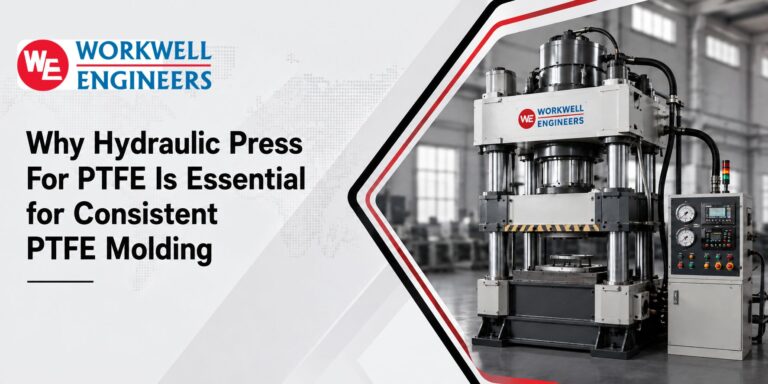
Among the machines that are used to provide good and reliable results in the molding process, it is worth mentioning the Hydraulic Press for PTFE because it allows applied controlled pressure, provides consistent compression of the material used in production and ensures quick cycles of production. Being different from many other types of plastics, PTFE requires special Hydraulic Presses to produce high-quality products that have the correct dimensions.
The present article reviews the necessity of the Hydraulic Press for PTFE in producing high-quality PTFE parts.
Getting to Know PTFE Molding
PTFE’s distinct molecular structure and extremely high melt viscosity do not allow it to be molded with traditional injection mold methods. Instead, companies resort to a process called compression molding, in which PTFE powder is placed in the mold cavity and compressed under specific pressure and later goes through a sintering procedure.
Practically speaking, the compression molding process is widely used for manufacture of:
- PTFE sheets,
- PTFE rods,
- PTFE tubes,
- PTFE bushes,
- PTFE seals,
- PTFE gaskets,
- PTFE custom engineering components.
Such products’ quality depends greatly on the ability to control pressure along the process.
Why Is It Important to Do Everything the Same Way in PTFE Molding?
Any company producing PTFE products should pay great attention to making sure the products comply with required specifications. Even minimal pressure or shape deviations lead to rejecting some of the products.
The use of a suitable Hydraulic Press for PTFE allows avoiding a variety of problems like:
- Unequal density of the material.
- Air bubbles.
- Surface defects.
- Mistakes in dimensions.
- Internal cracks.
- Material waste.
Consistent manufacturing leads to greater reliability of the product and less costs for production.
How a PTFE Hydraulic Press Guarantees Results
- Pressures are Uniform Throughout the Press Cycle
The powder should be distributed evenly in the mold and that the forces are uniform. Non-uniform pressure can create density variances which would negatively impact the products.
The Hydraulic Press For PTFE makes sure that the pressure during the molding process is uniform.
- Dimensions Are Controlled Effectively
In the industries using PTFE production, there are strict requirements to create tight tolerance manufacturing. A small dimensional deviation can cause a leak or poor assembly of products.
Modern hydraulic presses can move their rams with excellent precision and ensure that the molding process goes smoothly.
- The Surface Finish of PTFE Parts Is Enhanced
Thanks to proper pressure, the surfaces of the parts produced are smooth which excludes the need for secondary operations.
If the compression is carried out correctly, the surface of the parts will be smoother since there will be less need for secondary machining and finishing.
The uniform compression process also helps to prevent defects such as
– Surface voids
– Cracks
– Imperfect edges
– Warping.
This allows for the manufacturing of high-quality PTFE parts that meet the requirements of demanding industrial applications.
- Greater Material Density
Material density is one of the key indicators of quality of PTFE parts.
A reliable Hydraulic Press For PTFE ensures the following:
– Constant pressure in the mold
– A small number of internal voids
– Good mechanical properties
– Good wear resistance
– Long service life of the product.
This uniformity is especially significant in those cases where the parts should work under high temperatures and high pressure.
- Consistent Production Cycle
Mass production of PTFE parts requires each production cycle to be exactly the same.
Programmable hydraulic presses allow the operators of the machines to achieve the following:
– Constant pressure during the work
– Measured stroke length
– Precise pressing time
– Repeatability of the process.
Such a way of production helps avoid variations in production processes.
Why Using a Special Purpose Hydraulic Press is Necessary
Manufacturing PTFE demands specialized equipment instead of regular hydraulic presses. Different types of PTFE require different mold sizes, thrusts, daylight height, and work time.
A Special Purpose Hydraulic Press is designed to meet all the production needs. According to the information from Workwell Engineers, this press can withstand complicated industrial processes, by offering customized specifications and precise performances that enable it to comply with PTFE production requirements.
Depending on manufacturing features, hydraulic presses can be used in their different forms:
- Vertical hydraulic presses
- Horizontal hydraulic presses
- Up-stroke hydraulic presses
- Down-stroke hydraulic presses
- Double action presses
- PLC-controlled automatic hydraulic presses.
These customized devices allow achieving good efficiency and keeping the quality of molding.
Main Points to Pay Attention to While Choosing a Hydraulic Press For PTFE
Choosing the right press requires considering some important points.
High Pressing Capacity
- Each product using PTFE needs different levels of force for compressing it. Picking the right tonnage is important for ensuring that the material is compacted properly without causing any damage to the mold.
Precision Hydraulic Control
- A constant hydraulic pressure leads to better dimensional consistency and fewer defects produced in the process.
Strong Machine Construction
- Having a robust design ensures minimal deformation while pressing, which helps to keep the machines aligned properly.
Automation Compatibility
- Using PLCs for controlling processes leads to higher degree of repeatability while eliminating dependance on the operator.
Energy Efficiency
- Modern hydraulic systems consume less energy but still keep efficiency of the pressing process.
Operator safety
- Additional safety features such as overload protection and emergency stop allow to make the process safer.
Benefits of Using Advanced Hydraulic Press Technology
The investment in an advanced Hydraulic Press For PTFE will give long-term benefits.
These benefits include:
- Higher production volumes
- Lower wastage
- Better quality of the product
- Lower maintenance
- Better reliability of the machine
- Faster production cycles
- Higher client satisfaction
Manufacturers would benefit in the scale of production.
Why Manufacturers Choose Workwell Engineer
Choosing the correct equipment partner is of the utmost importance for businesses related to PTFE production.
A Workwell Engineer has years of experience in the field of engineering. The company is widely recognized for designing and manufacturing high-quality special purpose hydraulic press solutions that can satisfy even the most complex industrial requirements. The hydraulic press produced by the organization can offer quality, reliability, and customization.
Manufacturers of PTFE sheets and rods can be sure of producing quality products because hydraulic presses are specially designed for the production process.
Guidelines for Proper PTFE Molding
Even the advanced hydraulic machine works perfectly well when the right manufacturing methods are applied.
To get good molding results, one should:
- Use high-quality PTFE raw materials;
- Keep the tools clean;
- Choose the proper pressure for each product;
- Use proper performing and sintering techniques;
- Calibrate the hydraulic systems from time to time;
- Carefully check the seals, cylinders, and hydraulic machine elements;
- Monitor parameters of pressing throughout the process of production.
Summary
Generating sturdy PTFE parts necessitates flawless management of every part of the production process. Hydraulic Press For PTFE guarantees the control over pressure and stability required to produce parts with consistent density, right parameters and excellent performance.
As demand for high-quality PTFE products increases in industrial processes, getting a good Special Purpose Hydraulic Press is an important investment to boost production efficiency and competitive level of manufacturing.
Using hydraulic presses from Workwell Engineer it’s easier for manufacturers to adjust their PTFE operation, eliminate errors during production and get desired results of production.